
Key Takeaways
- •Peptide libraries contain several million or more peptides organized by their amino acid sequences.
- •Many scientists order these libraries from suppliers, receiving them promptly.
- •Parallel libraries represent the most basic combinatorial approach.
Basics of Peptide Libraries
Peptide libraries contain several million or more peptides organized by their amino acid sequences. These collections form mixtures of peptide chains and amino acids, which play key roles in biological processes. Companies specializing in peptides and biological materials produce them, or researchers synthesize them in equipped labs.
Many scientists order these libraries from suppliers, receiving them promptly. Such materials remain accessible to all interested parties since regulators do not classify peptides as hazardous, unlike viruses or other risky agents. This availability speeds up research workflows for labs needing specific peptides.
Main Types of Peptide Libraries
Parallel libraries represent the most basic combinatorial approach. In this setup, each unique peptide sequence synthesizes within its own reactor to maintain high purity. Yields stay modest, but automation and microwave methods boost the process efficiency.
Random libraries, by contrast, produce millions of varied peptide sequences per reactor. This design suits high-throughput screening of numerous candidates quickly.
Features of Overlapping Peptide Libraries
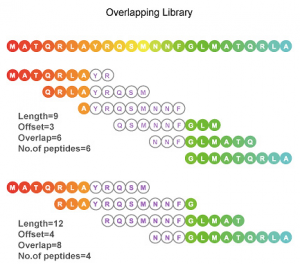
Overlapping peptide libraries create sets of peptides that span the complete sequence of a chosen protein. Users set parameters such as peptide length and amino acid offset values (see Figure 1). The resulting designs allow editing and export into Word or Excel files.
Design relies on two factors: peptide length and offset count. Sequences cut progressively from the protein's N-terminus to C-terminus, shifting by one or several amino acids each step to ensure overlaps. This method yields a complete overlapping peptide library.
Figure 1 illustrates the structure of an overlapping peptide library.


Production Techniques
One method synthesizes genes for random polypeptide segments artificially. These genes clone into phage vectors, displaying peptides on phage surfaces via epitope display technology to build the library. Many libraries form on solid supports like resins or beads and package into vials or test tubes.
Screening draws on interactions between macromolecules. From the library, researchers select small molecules that replicate functions of target macromolecules, using responses akin to antigen-antibody binding.
Research Uses of Overlapping Peptide Libraries
Peptide libraries serve diverse studies, including amino acid combination effects. They help pinpoint specific peptides and clarify cellular peptide functions. In drug discovery, they reveal active compounds.
Additional roles cover protein purification and synthetic vaccine creation. They also probe intracellular signaling pathways. Overlapping versions target short sequences from proteins or long peptides to find antigen peptides, enzyme substrates, and T cell epitopes.
Key References
Lam K S, Salmon S E, Hersh E M, et al. A new type of synthetic peptide library for identifying ligand-binding activity[J]. Nature, 1991, 354(6348): 82-84.
Schatz P J, Cull M G, Miller J F, et al. Peptide library and screening method[J]. EP, 2000.
Reese G, Ayuso R, Leong-Kee S M, et al. Characterization and identification of allergen epitopes: recombinant peptide libraries and synthetic, overlapping peptides[J]. Journal of Chromatography B: Biomedical Sciences and Applications, 2001, 756(1-2): 157-163.
Li X, Wang L, Zhao D, et al. Identification of host cell binding peptide from an overlapping peptide library for inhibition of classical swine fever virus infection[J]. Virus genes, 2011, 43(1): 33-40.


